SKRIPSI TADRIS BAHASA INGGRIS
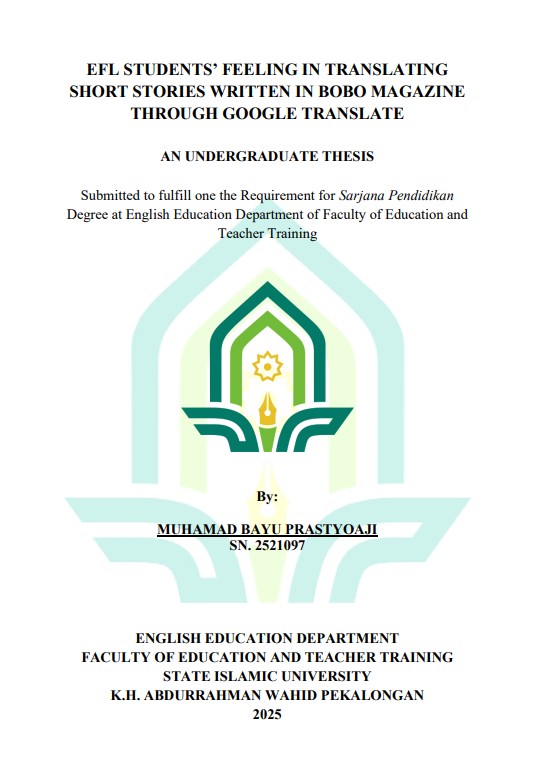
Efl Students' Feeling In Translating Short Stories Written In Bobo Magazine Through Google Translate
This study aims to explore the feelings of EFL (English as a Foreign Language) students when translating short stories from BOBO magazine using Google Translate. The background of the study emphasizes the importance of understanding emotional responses in the translation process, especially when using digital tools. Based on Appraisal Theory by Martin and White (2005), emotional reactions such as happiness, satisfaction, anger, and anxiety are considered influential in shaping students’ motivation and engagement during learning. The use of BOBO short stories—rich in cultural content yet linguistically simple—presents a unique challenge in translation. Unlike prior studies that mostly focused on the technical use of Google Translate, this research fills the gap by examining the emotional experiences of students during translation. This research employed a qualitative approach using a narrative design. Three English Education students who had taken a Translation course and translated BOBO stories were selected as participants. Data were collected through semi-structured interviews and analyzed using thematic analysis as proposed by Braun and Clarke (2006). The analysis followed four steps adapted from Widodo (2014): listening to recordings repeatedly, transcribing the data, interpreting participants’ statements, and building credibility through accurate interpretation. The emotional expressions were examined using the Affect domain of Appraisal Theory (Martin & White, 2005), which includes emotions such as happiness, satisfaction, anger, sadness, cheerfulness, and anxiety. This approach allowed the researcher to view emotions not just as psychological states but also as evaluative linguistic expressions shaped by the translation experience. The findings reveal that students experienced positive emotions, such as happiness and satisfaction, when translations were accurate and supportive. In contrast, negative emotions—such as anger and anxiety—emerged when translations were overly literal or failed to capture cultural meanings. The study concludes that Google Translate plays a dual role: serving as a helpful tool and a source of emotional tension. Therefore, it is crucial for students to use the tool critically while continuously developing analytical and cultural sensitivity in translation. The study also recommends that educators guide students in the wise integration of translation technologies and encourages future research on the intersection of emotion, language learning, and digital tools.
Ketersediaan
| 26SK2625038.00 | SK TI 26.038 MUH e | My Library (Lantai 3, Local Content) | Tersedia |
Informasi Detail
- Judul Seri
-
-
- No. Panggil
-
SK TI 26.038 MUH e
- Penerbit
- Pekalongan : Program Studi Tadris Bahasa Inggris FTIK UIN K.H. Abdurrahman Wahid Pekalongan., 2025
- Deskripsi Fisik
-
xiii, 60 hlm., 24 cm; Bibliografi: 32-35
- Bahasa
-
Inggris
- ISBN/ISSN
-
-
- Klasifikasi
-
420,7
- Tipe Isi
-
-
- Tipe Media
-
-
- Tipe Pembawa
-
-
- Edisi
-
-
- Subjek
- Info Detail Spesifik
-
-
- Pernyataan Tanggungjawab
-
Muhamad Bayu Prastyoaji (2521097)
Versi lain/terkait
Tidak tersedia versi lain
Lampiran Berkas
Komentar
Anda harus login sebelum memberikan komentar
 Karya Umum
  Filsafat
  Agama
Agama  Ilmu-ilmu Sosial
  Bahasa
  Ilmu-ilmu Murni
  Ilmu-ilmu Terapan
  Kesenian, Hiburan, dan Olahraga
  Kesusastraan
  Geografi dan Sejarah