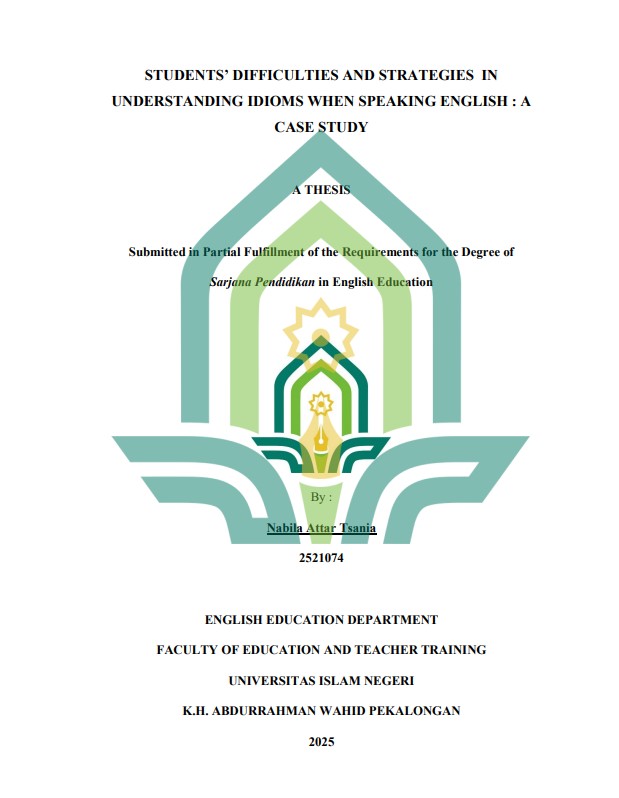
SKRIPSI TADRIS BAHASA INGGRIS
Students' Difficulties And Strategies In Understanding Idioms When Speaking English: A Case Study
Understanding idioms is a significant difficulty for learners of English as a foreign language (EFL), especially in speaking contexts that require spontaneous processing of meaning. Idioms have figurative meanings and are often culturally bound, making them difficult to understand literally, as stated by Fernando (1996). Based on Abel's (2003) theory of cognitive difficulties and Cooper (1999) on idiom learning strategies, this study aims to answer two main questions: (1) What difficulties do students face in understanding idioms when speaking English? and (2) How are the students' strategies in dealing with these difficulties?. This study aims to explore in depth the difficulties and strategies of university students in understanding idioms when speaking in English. Using a qualitative case study approach, data were collected through observations and interviews with four students (two male and two female) from the English Education Study Program at one of the universities in Pekalongan. The participants were purposively selected based on the results of previous observations in Speaking Club activities. Data were analyzed using the interactive model of Miles and Huberman (1994) which includes data reduction, data presentation, and conclusion drawing and verification. The findings indicated that students faced four main types of difficulties: (1) difficulties in accessing idiom meanings automatically, (2) inaccuracies in interpreting nondecomposable idioms, (3) difficulty connecting idioms with conceptual representations, and (4) uncertainty in the appropriate context of use. To overcome these difficulties, they apply several strategies, namely: (1) guessing the meaning of idioms from context, (2) using the literal meaning of idioms, (3) using background knowledge, and (4) referring to idioms in the first language. The findings provide important implications in English language teaching, especially in designing contextualized and communicative idiom learning to improve students' pragmatic competence.
Ketersediaan
| 26SK2625036.00 | SK TI 26.036 NAB s | My Library (Lantai 3, Local Content) | Tersedia |
Informasi Detail
- Judul Seri
-
-
- No. Panggil
-
SK TI 26.036 NAB s
- Penerbit
- Pekalongan : Program Studi Tadris Bahasa Inggris FTIK UIN K.H. Abdurrahman Wahid Pekalongan., 2025
- Deskripsi Fisik
-
xv, 61 hlm., 24 cm; Bibliografi: 57-61
- Bahasa
-
Inggris
- ISBN/ISSN
-
-
- Klasifikasi
-
420,7
- Tipe Isi
-
-
- Tipe Media
-
-
- Tipe Pembawa
-
-
- Edisi
-
-
- Subjek
- Info Detail Spesifik
-
-
- Pernyataan Tanggungjawab
-
Nabila Attar Tsania (2521074)
Versi lain/terkait
Tidak tersedia versi lain
Lampiran Berkas
Komentar
Anda harus login sebelum memberikan komentar
 Karya Umum
  Filsafat
  Agama
Agama  Ilmu-ilmu Sosial
  Bahasa
  Ilmu-ilmu Murni
  Ilmu-ilmu Terapan
  Kesenian, Hiburan, dan Olahraga
  Kesusastraan
  Geografi dan Sejarah